Why Pneumatic Actuators Lose Force: The Short Answer
When people ask why pneumatic actuators lose force, the honest answer is that force and speed loss almost always trace back to one of three places: not enough air pressure reaching the actuator, air escaping somewhere it shouldn’t, or mechanical resistance inside the actuator itself. A pneumatic actuator losing speed rarely happens overnight — pneumatic actuator force loss usually builds gradually as a filter clogs, a seal wears, or a fitting starts to weep air, which is why an actuator that worked fine for months can suddenly seem underpowered.
Pneumatic actuator troubleshooting works best when you treat force and speed as related but separate symptoms. An actuator that’s slow but still hits full stroke with normal force points somewhere different than one that stalls under load, and the sections below break down what each pattern usually means.
Low Air Pressure in Pneumatic Systems
Low air pressure in pneumatic systems is the most common root cause of a uniform slowdown, where the actuator moves sluggishly in both directions rather than favoring one. This usually points upstream of the actuator itself: an undersized compressor for current demand, a clogged filter element restricting flow, or several actuators drawing air at once and pulling header pressure down during peak cycles.
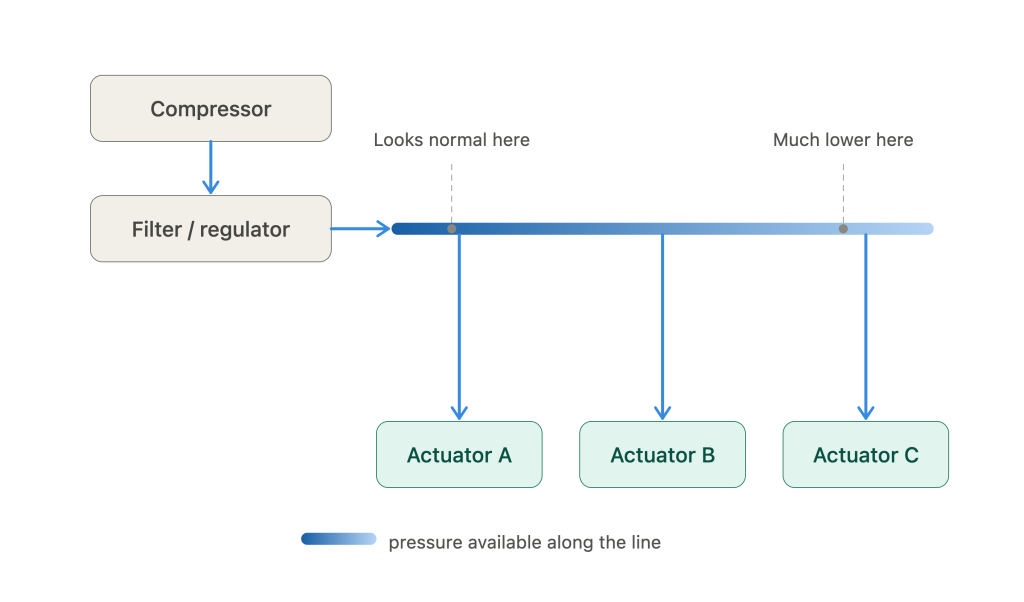
Since pneumatic force is a direct function of supply pressure acting on the piston area, even a modest pressure drop at the actuator inlet shows up as a real loss of usable force, not just a minor inconvenience. Checking pressure at the actuator itself during a stroke, rather than only at the compressor gauge, is the most reliable way to confirm this is the cause. Clean, properly regulated air, the kind maintained through air preparation systems, keeps this pressure stable at the point of use.
Pneumatic Actuator Air Leakage
Pneumatic actuator air leakage is easy to overlook because a small leak doesn’t stop an actuator outright — it just quietly reduces the pressure and volume available for the next stroke. Leaks tend to show up at fittings, tubing connections, and worn piston or rod seals, and they often get worse gradually rather than appearing as a sudden failure.
A hissing sound near a connection is the obvious sign, but many leaks are silent, especially internal ones where air bypasses a worn piston seal from one chamber to the other without ever reaching the outside air. That kind of internal leak is particularly deceptive, since the actuator can still complete its stroke, just with less force and a longer cycle time than before, which makes it easy to blame the wrong component.
Pneumatic Actuator Friction and Internal Resistance
Pneumatic actuator friction shows a different pattern than a pressure or leakage problem: the actuator often starts a stroke at normal speed and then loses momentum partway through, rather than being slow from the first movement. Contamination, dried-out lubrication, or seals that have swollen from heat or an incompatible lubricant all increase drag once the piston is in motion.
This kind of resistance is also the likely explanation when a pneumatic cylinder that’s moving slowly still reaches full pressure at rest but struggles as soon as it’s commanded to move. Misalignment between the actuator and the load it drives has a similar effect, since side-loading the rod adds friction a straight, well-mounted actuator would never experience.
Insufficient Pneumatic Actuator Force: Sizing and Load Problems
Insufficient pneumatic actuator force isn’t always a fault at all — sometimes the actuator was undersized for the job from the start, or the application has changed since it was specified. An actuator that performs well with no load but struggles the moment real resistance is applied is usually being asked for more force than its bore size and available pressure can reliably deliver.
This is worth checking before assuming something has failed: has the load gotten heavier, has friction increased elsewhere in the machine, or was the original sizing done with a safety margin that’s now being used up by wear elsewhere in the system. Replacing a worn actuator with an identical model won’t fix a genuine sizing problem.
Diagnosing the Pattern: A Quick Troubleshooting Table
The direction and timing of a slowdown usually says more about the cause than the actuator itself does. This table lines up common symptoms with where to look first:
| Symptom | Likely cause | Where to check first |
|---|---|---|
| Slow in both directions, from the start of the stroke | Low supply pressure or restricted airflow | Compressor output, filter condition, header pressure |
| Slow in one direction only | Valve or flow control issue on that side | Directional valve, flow control setting, tubing on that port |
| Starts normal, slows mid-stroke | Internal friction or contamination | Seals, lubrication, rod alignment |
| Works fine unloaded, weak under real load | Undersized actuator or increased load | Bore size, application load, safety margin |
| Gradual slowdown over weeks or months | Air leakage, wear, or contamination buildup | Fittings, seals, filters |
None of these checks require guesswork — they just require testing pressure and airflow at the actuator itself rather than assuming the problem starts there.
Pneumatic Actuator Troubleshooting in Canadian Manufacturing
Pneumatic actuator troubleshooting carries real weight in Canadian manufacturing, where a stalled actuator on an automotive line or an electronics assembly cell can halt production immediately. Ontario’s automotive sector alone accounts for roughly 10% of the country’s manufacturing GDP, and Canada’s electronics and semiconductor industry is valued at close to 4 billion dollars — both are sectors where actuator downtime is measured in real cost per minute, not just inconvenience.
Humphrey Automation supports manufacturers across Ontario, Ottawa, and Montreal with actuators, air preparation equipment, and replacement components from AirTAC, Koganei, and Fabco-Air, across industries from automotive to food and electronics. If a recurring force or speed problem is affecting a production line, our team can help isolate whether it’s a supply, leakage, or sizing issue rather than guessing at a fix.
Frequently Asked Questions
Why does my pneumatic actuator seem weaker than it used to be?
Gradual force loss is usually a sign of a slow air leak, worn seals, or a filter that’s becoming restrictive, all of which reduce the effective pressure reaching the actuator without causing an obvious failure.
How can I tell if it’s a pressure problem or a friction problem?
A pressure problem usually causes uniform slowness in both directions from the start of the stroke. Friction tends to show up as normal starting speed that fades partway through the stroke.
Can a pneumatic actuator lose force without any visible leak?
Yes. Internal leakage past a worn piston seal moves air between chambers without ever reaching the outside air, so there’s no hissing sound to give it away.
Is a bigger actuator always the fix for insufficient force?
Not necessarily. If pressure, leakage, and friction haven’t been ruled out first, replacing the actuator with a larger one can mask the real problem instead of solving it.
Getting Consistent Force and Speed Back
Most pneumatic actuator performance problems come down to air not arriving at full pressure, air escaping along the way, or something inside the actuator working harder than it should. Working through supply pressure, leakage, and friction in that order, before assuming the actuator itself has failed, usually finds the real cause faster than replacing parts on a guess.
If you’re dealing with a persistent force or speed issue on a production line, our team can help you check the system and match the right actuator, seals, or air preparation components to get it running reliably again — get in touch or browse our actuators range.