Quick answer: IoT in manufacturing means connecting machines, sensors, and software so production equipment can report its condition and performance in real time. Plants use that data for predictive maintenance, quality inspection, energy monitoring, and asset tracking. The main benefits are better equipment reliability, steadier product quality, and clearer visibility into costs such as maintenance and energy.
What Is IoT in Manufacturing?
The Internet of Things (IoT) is a network of physical objects with embedded sensors, processing ability, and software that connect and exchange data with other devices and systems. In a factory, the same idea is usually called the Industrial Internet of Things (IIoT): networked sensors, instruments, and machines tied into industrial applications such as manufacturing and energy management, as Wikipedia’s IIoT article describes.
Two related terms are worth defining:
- Smart manufacturing: production that uses connected equipment and live data to monitor and adjust processes instead of relying only on manual checks.
- Edge computing: processing data on or near the machine rather than sending everything to a remote cloud.
The role of IoT in smart manufacturing is to supply the live data that analytics and control software act on.
How Does IoT Work in a Factory?
IoT works in four stages: devices sense, networks transmit, software analyzes, and people or control systems act. The IIoT architecture on Wikipedia describes the same four layers (device, network, service, and content), shown here with a pneumatic example.
| Layer | What it does | Pneumatic example |
|---|---|---|
| Device | Sensors and machines generate data | A pressure sensor on a cylinder supply line |
| Network | Carries data over wired or wireless links | A controller reporting readings to a plant system |
| Service | Analytics software finds patterns and raises alerts | An alert when pressure drops below its normal range |
| Content | Dashboards and reports let people act | A maintenance view showing which line needs attention |
Shared protocols matter because equipment from different vendors has to exchange data. MQTT, for instance, uses a publish-subscribe model on top of TCP/IP, and OPC Unified Architecture was developed to enable secure, remote communication between devices, programs, and data sources.
What IoT Devices Are Used in Manufacturing?
IoT devices in manufacturing fall into three groups: devices that sense, devices that act, and devices that interpret what they see.
| Device type | Role on the line | Related category |
|---|---|---|
| Pressure, flow, temperature, and position sensors | Measure the condition of pneumatic components | Pneumatic sensors |
| Proportional valves | Adjust air pressure or flow in response to an electrical signal | Proportional valves |
| Stepper and servo motors with drives | Deliver precise, programmable motion | Electrical motion |
| Machine vision cameras | Inspect parts using AI | Inspekto S70 |
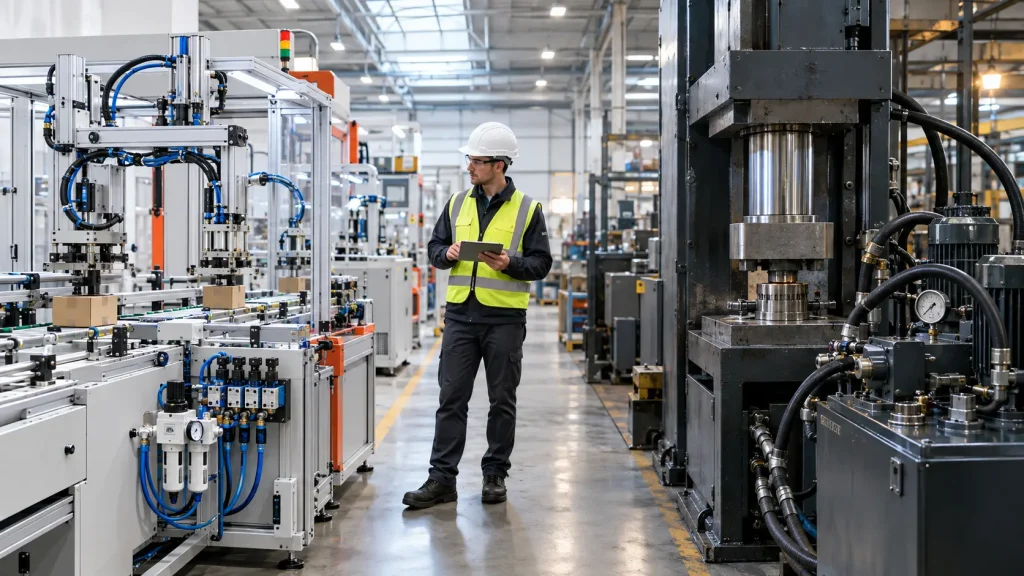
Pneumatic equipment is a practical place to start, because most plants already run pneumatic actuators, valves, and tubing across the line. Adding sensing to equipment that is already installed is usually simpler than replacing it.
How Is IoT Used in Manufacturing? Key Applications and Use Cases
The most common applications of IoT in manufacturing are predictive maintenance, quality inspection, energy monitoring, and asset tracking. Each one starts with a specific question the plant wants answered.
Predictive maintenance
Predictive maintenance uses live equipment data to schedule repairs before a failure. A typical IoT use case in manufacturing is a temperature or pressure reading that signals a pneumatic actuator is operating outside its normal range. Wikipedia calls predictive maintenance an easier IIoT application because it works with existing assets and management systems. It also cites studies suggesting maintenance costs may fall by up to 30% and breakdowns by up to 70%, which are best read as upper bounds rather than promises. For the practical side, see our guide to reducing downtime in automated pneumatic systems.
Quality inspection
Automated visual inspection uses cameras, sensors, and AI to check products for defects. Our overview of automated visual inspection covers the technique in detail. The Inspekto S70, for example, is a plug-and-inspect unit that needs no separate camera, lens, or lighting setup. It runs standalone on edge computing without cloud connectivity and needs about 20 OK images to set up a use case.
Energy and compressed air monitoring
Pressure sensors can reveal a drop in system pressure caused by a leak. Catching leaks early supports the efficiency work described in our guide to energy savings in pneumatic automation.
Asset tracking and inventory
IIoT also supports continuous inventory control and asset tracking. Wikipedia cites RFID tags on safety gear as one example of tracking people and equipment.
Digital twins
A digital twin is a virtual model of a process or machine. Manufacturers use it to test process changes and train employees without touching the live line.
What Are Some IoT in Manufacturing Examples by Industry?
IoT adds the most value where machines repeat precise motions all day, so the same tools appear in very different plants. Two examples from the industries we serve show how.
IoT in automotive manufacturing
Car manufacturing is one of the applications Wikipedia lists for IIoT. Our automotive and trucking page lists assembly lines, welding robots, EV battery assembly, stamping and pressing, and quality inspection. Fabco Air pancake cylinders handle pressing and stamping, AirTac MA mini cylinders support robotic interior assembly, and Inspekto S70 detects defects on parts such as gearboxes, bearings, and bodywork. Each of these is a point where sensors and monitoring software can track how the equipment performs.
IoT in food manufacturing
Our food processing and packaging page covers tasks such as bottle capping, vacuum packaging, palletizing, labeling, and conveyor speed control, plus inspection of bottling lines and thermoform trays. On a vacuum packaging line, for example, monitoring vacuum levels can show when a pad or fitting and tubing connection needs attention.
What Are the Benefits of IoT in Manufacturing?
The main benefits of IoT in manufacturing are fewer unplanned stoppages, more consistent quality, and better visibility. Wikipedia summarizes the gains as improved productivity, reliability, and analytics. In practice, each benefit traces back to one of the applications above, so a plant can measure it against its own baseline before scaling.
- Less unplanned downtime: predictive maintenance replaces surprise failures with scheduled repairs.
- Consistent quality: automated inspection checks every part the same way.
- Lower waste: leaks and worn components are found sooner.
- Better decisions: data from several machines shows where time and energy go.
- Safer workplaces: tracking can cover people as well as equipment.
How to Implement IoT in Manufacturing
The simplest way to implement IoT in manufacturing is to start with one measurable problem, connect the equipment that affects it, and expand only after a pilot proves its value.
- Define one problem. Pick a clear target, such as repeated stoppages on a single line.
- Audit existing equipment. Note which machines already have sensors or communication options and which do not.
- Choose sensors and connectivity. Match the measurement (pressure, flow, temperature, or position) to the failure you want to catch, and favor open protocols, since Wikipedia lists a lack of interoperability as a common challenge.
- Decide where data is processed. Edge processing keeps decisions close to the machine, while cloud tools suit plant-wide reporting.
- Run a pilot. Test on one line and compare results with the previous baseline.
- Scale and standardize. Repeat what worked across other lines.
A well-planned pneumatic system makes this easier, so our best practices for designing a pneumatic control system are a good companion. Clean, regulated supply from air preparation systems also gives sensor readings a stable baseline. For plants that need a tailored setup, our team offers custom solutions.
How Do You Handle IoT Security in Manufacturing?
Treat every connected device as a potential entry point. According to Wikipedia, each connected device can become a liability, and Stuxnet, a worm that affected industrial controllers, is one of the examples it cites.
Wikipedia’s IoT article lists the common weaknesses: weak authentication, unchanged default credentials, unencrypted messages between devices, and older devices that never receive patches. The practical response follows directly:
- Change default credentials before a device goes live.
- Require strong authentication and encrypt device messages.
- Choose devices whose vendors still issue updates.
- Keep sensitive processing local where possible. The Inspekto S70, for instance, runs without cloud connectivity.
What Is the Future of IoT in Manufacturing?
Current IoT trends in manufacturing point toward more processing at the edge, wider use of shared standards, and broader use of AI and digital twins. These directions are already visible in the tools described above rather than being distant predictions.
Standards are still developing. Wikipedia notes that the Industrial Internet Consortium’s reference architecture and Germany’s Industry 4.0 are independent efforts to define a standard for IIoT-enabled facilities. For the pneumatic side of this shift, see our look at Industry 4.0 in pneumatic systems.
FAQ
IoT in manufacturing is the use of connected sensors, machines, and software to collect and share equipment data, so plants can monitor, maintain, and improve production.
Predictive maintenance, automated quality inspection, energy and compressed air monitoring, and asset tracking are the most common. Most plants begin with one and expand.
Not necessarily. Wikipedia notes that predictive maintenance works with existing assets, and sensors can often be added to equipment already on the line.
It can be, if the basics are covered: unique credentials, encryption, regular updates, and devices from vendors that support them.
Start with one costly problem, such as recurring downtime, and run a pilot on a single line before scaling.
Plan Your First Connected Line
If you are planning a connected line, our industrial manufacturing page shows how pneumatic, electrical, and vision products fit together. Contact the team to talk through the right first step for your plant.