Quick answer: The main difference between hydraulic and pneumatic systems is the working fluid. Hydraulic systems use a nearly incompressible liquid, such as oil, at high pressure to deliver high force and responsive, stiff control. Pneumatic systems use compressed air at much lower pressure and offer simpler design, low maintenance, and a lower fire risk. Choose hydraulics when force is the deciding factor, and pneumatics when you need simple, fast, clean motion at moderate loads.
What Is the Difference Between Hydraulic and Pneumatic Systems?
It comes down to what carries the power. In a hydraulic system it is a liquid, typically oil. In a pneumatic system it is a gas, almost always compressed air. Pressure levels, force, stiffness, safety, and upkeep all follow from that single choice.
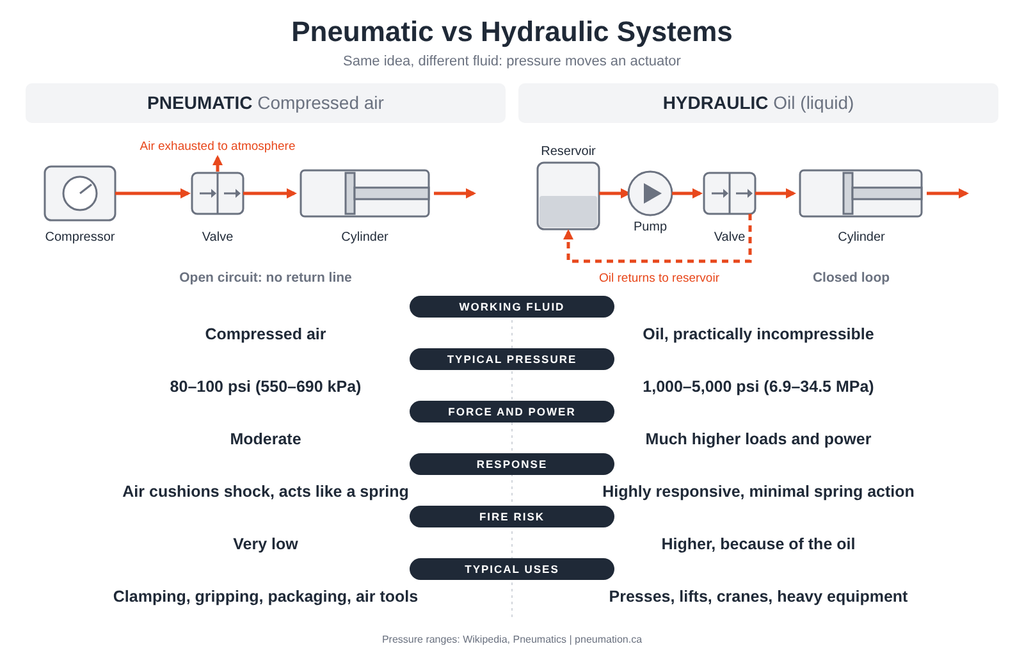
Both belong to fluid power: a pump or compressor pressurizes a fluid, valves direct it, and an actuator, usually a cylinder, turns the pressure into motion. According to Wikipedia’s Pneumatics article, most industrial pneumatic applications run at about 80 to 100 psi (550 to 690 kPa), while hydraulic applications commonly use 1,000 to 5,000 psi (6.9 to 34.5 MPa). That is at least a tenfold gap, which is why the two are rarely interchangeable.
What Do the Key Terms Mean?
- Working fluid: the substance that carries pressure through the system. Oil in hydraulics, air in pneumatics.
- Compressibility: how much a fluid shrinks under pressure. Air compresses easily and behaves like a spring. Oil barely compresses, so it transmits force almost directly.
- Actuator: the component that converts fluid pressure into motion, such as a cylinder or rotary actuator. Our guide explains what a pneumatic actuator is.
- Pascal’s law: a pressure change applied to a confined liquid is transmitted throughout it. This is why a small force on a small piston can produce a large force on a large one, as in a hydraulic press.
Hydraulic vs Pneumatic Systems at a Glance
| Factor | Pneumatic | Hydraulic |
|---|---|---|
| Working fluid | Compressed air (or another gas) | Liquid, typically oil |
| Typical pressure | About 80 to 100 psi (550 to 690 kPa) in most industrial uses | Commonly 1,000 to 5,000 psi (6.9 to 34.5 MPa) |
| Force and power | Moderate | Much higher loads and more power |
| Stiffness and response | Compressible air cushions shock but acts like a spring | Practically incompressible: highly responsive, minimal spring action |
| Fire risk | Very low | Higher, because of the oil |
| Leaks | Escaping air is not a contamination problem in most plants | Oil leaks need containment and cleanup |
| Design and upkeep | Simple design with standard cylinders; little maintenance | Reservoir, pump, and return lines; fluid condition needs attention |
| Typical uses | Clamping, gripping, pressing, packaging, air tools, brakes | Presses, lifts, cranes, heavy equipment |
How Do Pneumatic Systems Work, and What Are Their Pros and Cons?
A pneumatic system compresses air, treats it, and sends it through valves to actuators. Spent air is simply exhausted to the atmosphere, so there is no return line. The chain starts with an air compressor, continues through filters and regulators, and ends at the cylinder. Humphrey Automation’s air preparation systems range covers that middle stage with filters, regulators, and FRL (filter-regulator-lubricator) units, and pneumatic valves control where the air goes. If you want the mechanics at cylinder level, see the pneumatic actuator working principle.
Advantages
- Simple design and control. Machines are built with standard cylinders and can run on simple on-off control.
- Reliability. Pneumatic systems generally have long operating lives and need little maintenance.
- Shock tolerance. Because air is compressible, equipment is less exposed to shock damage, and new machines are usually overload-safe to a certain limit.
- Stored energy. Compressed air can be stored, so machines keep running for a while if electrical power is lost.
- Safety. There is a very low chance of fire compared with hydraulic oil, and escaping air is not a toxic leak.
Disadvantages
- Lower force. Air systems cannot match hydraulic power at the same cylinder size.
- Less stiffness. The same compressibility that absorbs shock makes it harder to hold a load rigidly or position it with precision.
- Energy cost. Compressed air is an energy-intensive utility, and leaks or excess pressure waste it quickly. Our article on energy savings in pneumatic automation shows where that waste usually hides.
How Do Hydraulic Systems Work, and What Are Their Pros and Cons?
A hydraulic system works in a closed loop. A pump draws oil from a reservoir and pressurizes it, valves direct it to cylinders or motors, and the oil returns to the reservoir. Because the liquid is practically incompressible, force transfers almost instantly, and Pascal’s law lets a small pump pressure be converted into a very large force at the actuator.
Advantages
- Much higher loads and more power than pneumatics can supply.
- Little spring action. The working fluid is practically incompressible, so the system is highly responsive and holds position well.
- Controlled release. When fluid flow stops, the slightest motion of the load relieves the pressure on it; no pressurized air has to be bled off.
- Multiple jobs. The oil also lubricates and cools while it transmits power.
Disadvantages
- Leaks. Oil leaks mean cleanup, contamination risk, and containment requirements.
- Fire risk. Hydraulic oil carries a higher fire risk than air.
- More plumbing and fluid care. Reservoirs, return lines, and fluid condition all need attention.
- High pressure. Working at thousands of psi demands robust components and disciplined safety practice.
Which Is Cheaper, Easier to Maintain, and Safer?
In a hydraulic vs pneumatic cost comparison there is no universal answer, because force requirements change the equation. For light and moderate loads, pneumatics is usually the more economical route: components are standardized, design effort is low, and there is no return line or fluid reservoir to manage. At high force, hydraulics delivers that force from far more compact actuators.
Running cost is a different question. Compressed air is expensive to generate relative to the work it delivers, so a plant with leaks pays for it continuously. Hydraulics trades that for fluid management: leaks, filtration, and oil condition.
On maintenance, pneumatic systems generally need little, and scheduled checks keep them that way. Our guide to reducing downtime in automated pneumatic systems covers a practical routine. On safety, the lower fire risk of air is a genuine advantage, although stored compressed air still deserves respect and lockout procedures.
What Are Examples of Hydraulic and Pneumatic Systems?
Pneumatic examples:
- Clamping, pressing, and part handling on production lines
- Gripping and material handling on assembly lines, as in our industrial manufacturing use cases
- Packaging equipment
- Dentistry, construction, and mining equipment
- Industrial process control
- Vehicle air brakes
Hydraulic examples:
- Hydraulic presses, which use Pascal’s law to multiply a small force into a large one
- Lifts and cranes, which 19th-century cities powered through citywide hydraulic networks
- Heavy mobile equipment such as excavators, where high force from a compact actuator is the priority
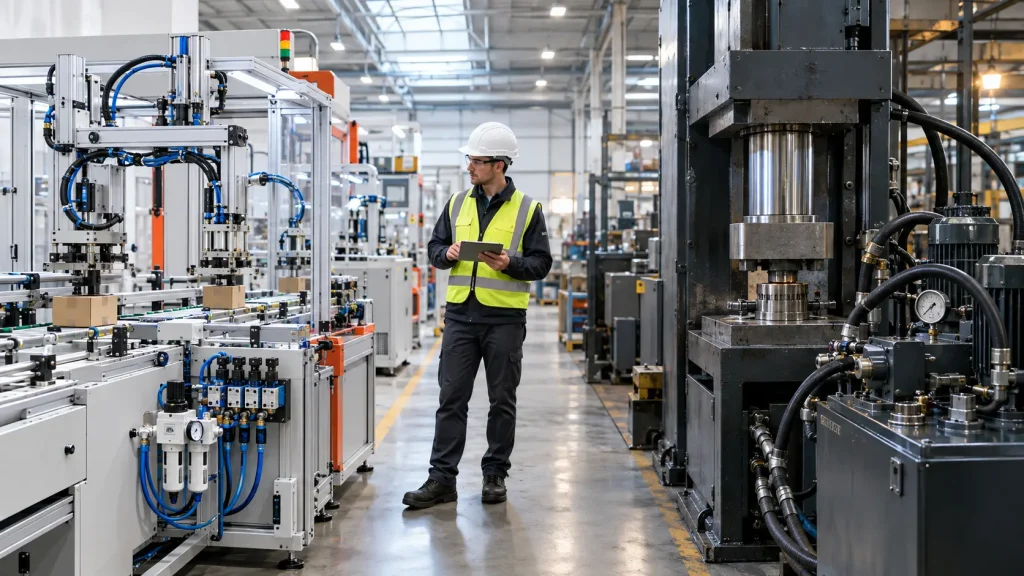
Most facilities use both, in different places. A press line may rely on hydraulics for the forming stroke and on pneumatics for clamping, part transfer, and tooling.
How Do You Choose Between Hydraulic and Pneumatic Systems?
Start with force, then work through the rest. In a pneumatic vs hydraulic decision, these six questions settle most cases:
- How much force does the job need? If it is beyond what a reasonably sized air cylinder can deliver, hydraulics is the likely answer.
- How fast and how often does it move? Short, repetitive strokes at moderate load suit pneumatics.
- How precisely must it hold or position a load? Stiff, accurate holding favours hydraulics, because air acts like a spring.
- What does the environment tolerate? Where oil leaks or fire risk are unacceptable, pneumatics has the edge.
- What infrastructure already exists? A plant with compressed air at every station can add pneumatic actuators far more cheaply than it can build a hydraulic power unit.
- Who will maintain it? Pneumatic systems are simpler to look after; hydraulic systems reward disciplined fluid management.
| If your priority is… | Lean toward |
|---|---|
| Very high force from a compact actuator | Hydraulic |
| Rigid load holding and responsive control | Hydraulic |
| Fast, repetitive, light-to-moderate motion | Pneumatic |
| Low fire risk and clean operation | Pneumatic |
| Simple design and low maintenance | Pneumatic |
If pneumatics fits, our guide to selecting the right pneumatic cylinder covers bore, stroke, and mounting, and the best practices for designing a pneumatic control system cover the circuit around it.
Is an Electric Actuator Worth Considering?
Sometimes. Electric actuators win when precise, programmable positioning matters more than raw force or speed. That comparison has its own treatment in pneumatic actuator vs electric actuator, so it is not repeated here.
FAQ: Hydraulic and Pneumatic Systems
Hydraulic. It commonly runs at 1,000 to 5,000 psi, compared with about 80 to 100 psi for most industrial pneumatics, and it can move much higher loads.
Compressed air does not burn, while hydraulic oil does, so pneumatic systems carry a very low chance of fire by comparison.
Oil is practically incompressible, so it transfers force almost directly and leaves minimal spring action. Air compresses, so it cushions and flexes under load.
Usually not at very high forces. Air pressure is far lower, so the cylinder would have to be impractically large. For moderate loads, though, pneumatics is often the simpler and cleaner choice.
Pneumatics is generally the better fit, because those tasks involve fast, repetitive, light-to-moderate motion and benefit from simple, low-maintenance design.
Choosing the Right System for Your Application
The best system is the one that matches your force, speed, and environment, not the one that is stronger on paper. Humphrey Automation supplies pneumatic components and electrical motion products to manufacturers across Canada, and our actuators range covers a wide span of cylinder types. For an application that falls between the two approaches, our team also handles custom automation solutions.