Quick answer: In the automotive industry, machine vision uses cameras, sensors, and software to inspect surfaces for defects, verify assembly, guide robots, measure and align components, and track parts by barcode — doing it continuously, at production-line speed, with a consistency manual inspection can’t match.
What Is Machine Vision in Automotive Manufacturing?
Machine vision refers to the use of cameras, sensors, and software that let machines interpret visual information and act on it automatically — a discipline sometimes distinguished from broader computer vision research by its focus on real-world industrial tasks, as Wikipedia’s overview explains. In the machine vision automotive industry, these systems inspect parts, measure dimensions, guide robots, and verify quality at every stage of production, from body assembly through final inspection.
Unlike a person on the line, an automated visual inspection system runs continuously with the same accuracy on part one and part ten thousand. It can catch micro-defects invisible to the human eye, confirm that an assembly step was completed correctly, and feed real-time position data to robots. With AI layered on top, machine vision in automotive manufacturing can now learn defect patterns rather than only checking against fixed rules — for the broader picture of how these systems are built, see our guide to types of machine vision systems.
Why Does the Automotive Industry Rely on Machine Vision?
Automotive production combines four pressures that manual inspection alone can’t satisfy:
- High production speed — lines run too fast for manual, part-by-part checks to keep pace.
- Strict quality requirements — automotive OEMs hold tolerances that manual processes struggle to meet consistently.
- Complex assemblies — a single vehicle contains thousands of components that must be verified in the correct position.
- Safety-critical components — a missed defect in a structural or safety part risks a recall, not just a warranty claim.
This is also where machine vision for automotive quality control pays for itself: a defect caught late on the line is far more expensive to fix than one flagged early. Vision systems also give robots the real-time feedback they need to align, assemble, and verify parts without a person in the loop — see our broader look at automotive and trucking automation for how this fits into the wider production line.
What Are the Key Applications of Machine Vision in the Automotive Industry?
How Is Machine Vision Used for Defect Detection on Body and Paint Surfaces?
Automotive visual inspection is one of the most common applications of machine vision on the line, catching scratches, dents, paint inconsistencies, and surface contamination on car bodies and painted components. High-resolution cameras paired with controlled lighting capture detailed images, and the software flags imperfections too small for a human inspector to reliably catch — run continuously, these automotive visual inspections hold a standard that’s hard to sustain with manual checks alone.
Automotive machine vision inspection increasingly relies on AI-based classification to reduce false positives, which matters most in high-end manufacturing, where surface quality affects brand perception directly. The same underlying approach is covered in more depth in how machine vision improves quality control.
How Does Machine Vision Verify Assembly on the Line?
Assembly verification confirms that every component — bolts, connectors, clips, wiring — is present, correctly positioned, and properly oriented before the vehicle moves to the next station. Machine vision on the automotive assembly line captures an image at each stage and compares it against a reference standard, catching a missing or misaligned part before it becomes a functional or safety issue further down the line.
How Is Machine Vision Used for Robotic Guidance in Automotive Manufacturing?
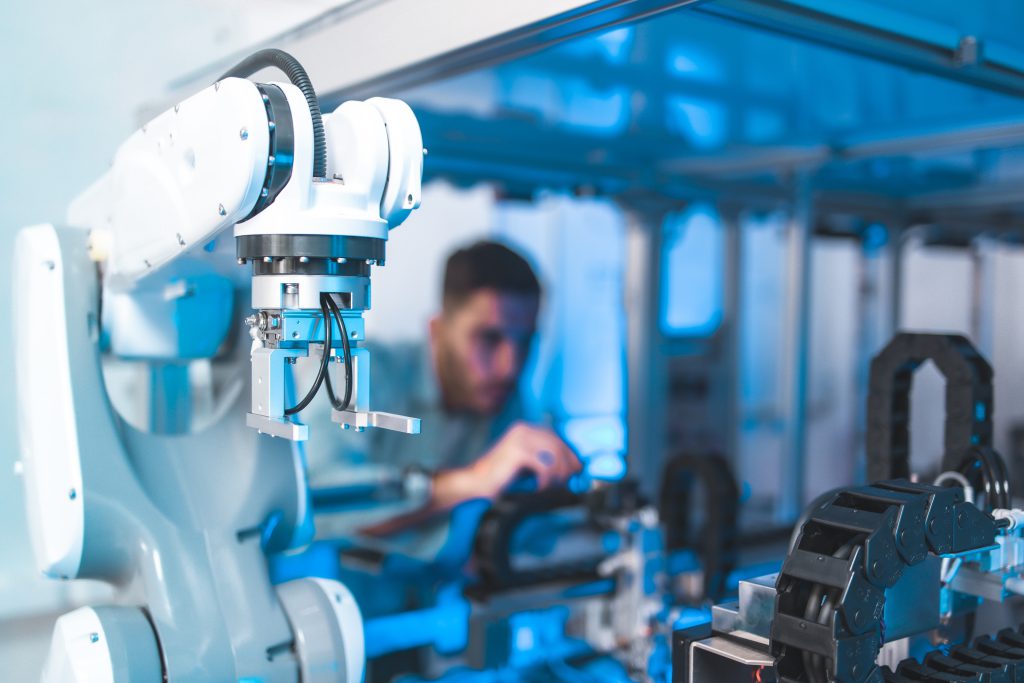
Automotive industry robotics depend on machine vision for real-time positioning: cameras tell a robot where a part actually is, not just where it’s supposed to be, so it can pick, place, weld, or assemble accurately. In welding and assembly specifically, vision-guided robotic arms are often paired with precision motion hardware like RTA’s stepper and servo drives to translate that visual feedback into accurate, repeatable movement. In more advanced setups, AI-based vision also lets robots adapt to minor part variation without manual reprogramming, which keeps flexible lines running without downtime for recalibration.
How Is Machine Vision Used for Measurement and Alignment?
Measurement and alignment checks confirm that components sit within tolerance before welding or assembly — a deviation of even a millimeter can affect fit, finish, or structural performance down the line. 3D vision systems are common here, since they add depth information that 2D imaging alone can’t capture, which matters most in body assembly and other structural work.
How Is Machine Vision Used for Part Identification and Traceability?
Automotive production tracks thousands of parts across a single line, and machine vision systems read barcodes, QR codes, and serial numbers to keep that traceable — supporting inventory management, quality control, and, when needed, a targeted recall rather than a blanket one.
What Types of Machine Vision Systems Are Used in the Automotive Industry?
Different applications call for different hardware:
| System Type | Best Suited For |
|---|---|
| 2D machine vision | Surface inspection |
| 3D vision systems | Measurement and alignment |
| Area scan cameras | General-purpose inspection |
| Line scan systems | Continuous materials |
| AI / deep learning systems | Complex or variable defect detection |
| Multi-camera systems | Complex, multi-angle assemblies |
What Are the Benefits of Machine Vision in Automotive Manufacturing?
- Improved quality control — consistent inspection removes the variability of manual checks.
- Higher production speed — automated systems keep pace with the line instead of becoming the bottleneck.
- Lower costs — catching defects early reduces scrap, rework, and the cost of a recall.
- Deeper automation — vision extends automation into inspection and assembly, not just material handling.
- Scalability — AI-based systems adapt to new models and production changes without a full redesign.
What Challenges Come with Implementing Machine Vision in Automotive Manufacturing?
What Lighting Challenges Affect Automotive Vision Systems?
Lighting is one of the most critical variables in any automotive vision system manufacturing setup. Reflective surfaces — painted bodies, bare metal — create glare and shadow that cause false detections or missed defects. Reliable results usually mean designing diffuse, directional, or structured lighting around the specific application, not using a one-size-fits-all setup.
How Complex Is Integrating Machine Vision Into an Existing Line?
Machine vision rarely runs on its own — it has to work with PLCs, robots, conveyors, and the rest of the automation stack already on the floor. That means synchronization, reliable data flow, and sometimes custom software, which is why system architecture needs to be planned from the start rather than bolted on afterward.
Can Machine Vision Keep Up With High-Speed Automotive Production?
Automotive lines can process hundreds or thousands of parts an hour, so the vision system has to capture and process images in real time without becoming the bottleneck. That requires high-performance cameras, efficient algorithms, and processing hardware sized for the line’s actual throughput, not just its nominal speed.
How Do Machine Vision Systems Handle Variability in Parts?
Real parts aren’t perfectly identical — shape, color, positioning, and surface condition all vary within tolerance. Traditional rule-based systems can struggle with that variability; AI-based systems generally handle it better, since they learn from data rather than checking against a single fixed template. That said, training an AI model well requires a solid, validated dataset, not just more cameras.
What Does Machine Vision Cost, and What’s the ROI?
Implementing industrial machine vision for automotive involves upfront investment in hardware, software, integration, and ongoing maintenance. Most manufacturers recover that through fewer defects and less downtime, but it’s worth sizing the system to the actual application rather than over-specifying for complexity the line doesn’t need.
How Do You Choose the Right Machine Vision System for an Automotive Application?
- Define the application — inspection, measurement, or robotic guidance each point toward different hardware.
- Choose the right technology — 2D, 3D, or AI-based, matched to the task rather than to what’s newest.
- Consider the environment — lighting, line speed, and production conditions all shape what will actually work.
- Evaluate complexity — a smart camera may cover a simple check; a complex inspection usually needs a full PC-based system.
- Plan for scalability — choose a system that can adapt as production changes, not just one that fits today’s line.
Systems like the Inspekto S70 show how far this has come: an AI-based machine vision platform built to deploy with minimal setup, worth a look for manufacturers weighing custom integration against a ready-made system.
FAQ: Machine Vision in the Automotive Industry
Mainly defect detection, assembly verification, robotic guidance, measurement and alignment, and part traceability — covering nearly every stage from body assembly to final inspection.
AI-based systems learn from data instead of only checking against fixed rules, which lets them catch more complex, variable defects and adapt to new parts without manual reprogramming.
2D systems are typically used for surface inspection, while 3D systems add the depth information needed for precise measurement and alignment, particularly in body assembly and structural work.
Yes, in most cases, but it has to integrate with the PLCs, robots, and conveyors already running the line, which usually means some custom software and careful system planning rather than a plug-and-play install.
It typically involves meaningful upfront investment, but most manufacturers recover that through fewer defects, less rework, and lower recall risk — sizing the system correctly matters more than buying the most advanced one available.
Where Machine Vision Is Headed in Automotive Manufacturing
Machine vision is reshaping automotive manufacturing into a faster, more consistent, and more traceable process, from the first body panel through final inspection. As AI-based inspection and robotic guidance mature together, industrial machine vision automotive solutions are likely to keep taking on more of the judgment calls that used to require a person on the line. Humphrey Automation supplies industrial automation components and vision technology for manufacturers building or upgrading automotive production lines, and for applications that need a more tailored setup, our team also handles custom automation solutions.