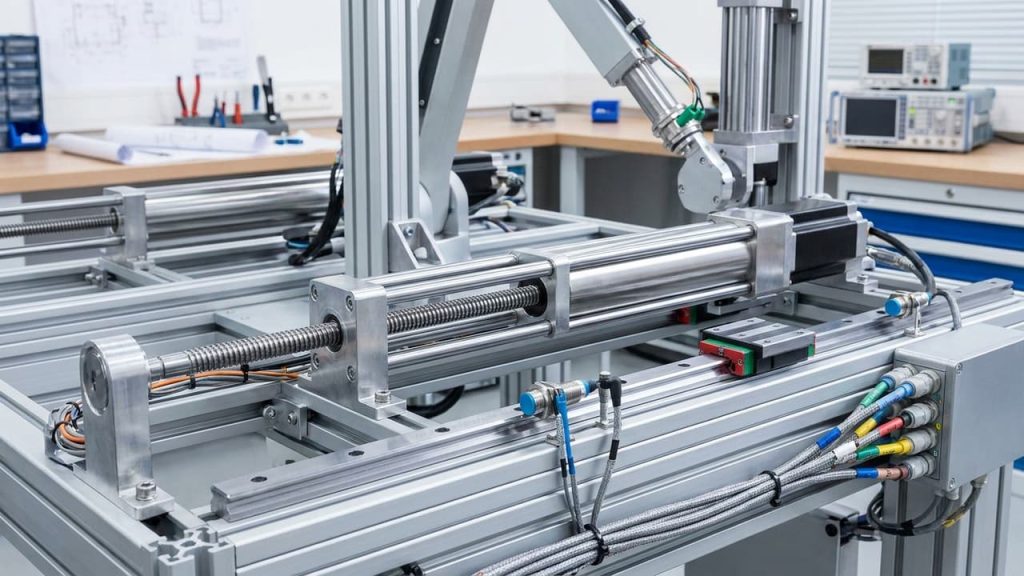
Quick answer: A pneumatic linear actuator uses compressed air to produce straight-line push-pull motion, while a rotary pneumatic actuator uses compressed air to produce rotational movement around a fixed axis. The right choice comes down to the type of motion your equipment needs — straight-line force along a stroke, or torque around a pivot point.
What Is the Difference Between a Linear and a Rotary Pneumatic Actuator?
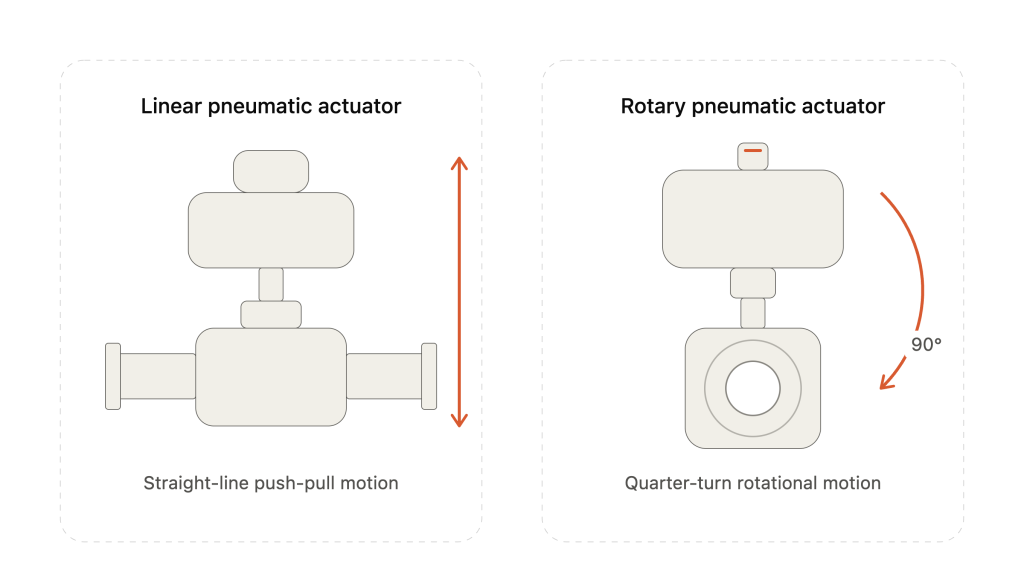
The main difference is the direction of the output motion. A linear pneumatic actuator — most commonly known as a pneumatic cylinder — extends and retracts along a straight path. A rotary pneumatic actuator turns a shaft through a defined angle, typically 90°, 180°, or a full 360°. Both actuator types run on the same compressed air supply and convert it into mechanical work, but the resulting motion, mounting style, and typical applications differ significantly. Understanding this distinction is the first step in choosing the right type of pneumatic actuator for a given task.
What Is a Linear Pneumatic Actuator?
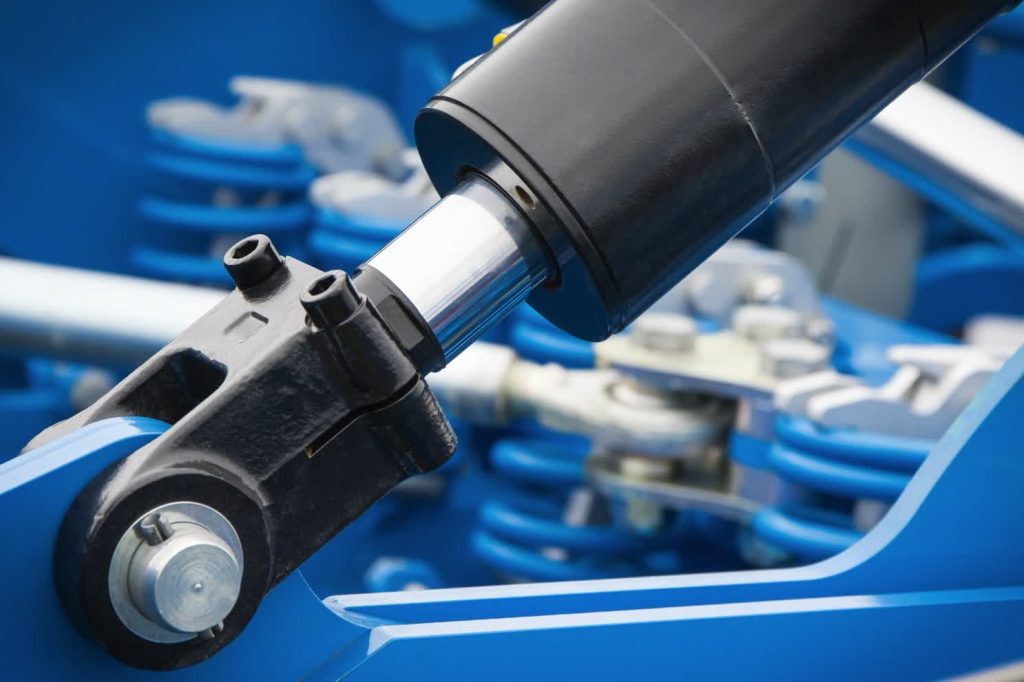
A linear pneumatic actuator, or linear motion actuator, is a device in which compressed air drives a piston back and forth inside a cylinder bore, producing straight-line motion. This is what most people picture when they hear the term “pneumatic cylinder.” Air enters one side of the piston to extend the rod and, in a double-acting design, enters the opposite side to retract it; single-acting versions rely on a spring to return the piston once air pressure is released.
Linear actuators are available in standard NFPA-dimensioned formats, custom bore-and-stroke configurations, and compact or rodless designs for tight installations. Humphrey Automation supplies both standard and custom NFPA cylinders from AirTac, built to specific bore, stroke, and mounting requirements. Typical applications include pushing, lifting, clamping, pressing, and short-stroke positioning on assembly and packaging lines. For guidance on sizing one correctly, see our guide on how to select the right pneumatic cylinder for your application.
What Is a Rotary Pneumatic Actuator?
A rotary pneumatic actuator, sometimes called a rotary air actuator, converts compressed air into rotational output instead of straight-line motion. Internally, this is usually achieved with a rack-and-pinion mechanism, where two opposing pistons drive a geared pinion, or with a vane design, where air pressure pushes against a vane fixed to the output shaft. Unlike an electric motor, most rotary pneumatic actuators are part-turn devices — they rotate through a fixed angle and stop, rather than spinning continuously.
This makes them well suited to quarter-turn valve automation, indexing tables, sorting flaps, and gripper rotation, where a component needs to pivot between two or more fixed positions repeatedly and reliably. Many rotary actuators, including Fabco rotary actuators, follow the ISO 5211 mounting standard, which standardizes flange dimensions and drive shaft interfaces so an actuator can be paired directly with a compatible valve without a custom bracket. Koganei also supplies actuators used in gripping and rotation tasks across similar automation setups.
How Do Linear and Rotary Pneumatic Actuators Compare Side by Side?
Because both actuator types run on the same compressed air supply, a side-by-side comparison is often the clearest way to see where each one fits.
| Feature | Linear Pneumatic Actuator | Rotary Pneumatic Actuator |
|---|---|---|
| Motion produced | Straight-line (push/pull) | Rotational (part-turn, e.g. 90°–360°) |
| Common mechanism | Piston inside a cylinder bore | Rack-and-pinion or vane |
| Typical output | Force along a stroke | Torque around a shaft |
| Everyday name | Pneumatic cylinder | Rotary air actuator |
| Typical uses | Pushing, lifting, clamping, pressing | Valve operation, indexing, gripper rotation |
| Mounting style | Bore/stroke-based, various trunnion or flange styles | Often ISO 5211 flange-mounted |
| Continuous rotation | No | No — part-turn only, unlike an electric motor |
This pneumatic actuator comparison shows that the decision is rarely about which actuator is “better” overall — it is about matching the motion type to the mechanical task at hand. Both remain among the most widely used types of pneumatic actuators in industrial automation, and in shop-floor language, this same distinction is often just described as pneumatic cylinder vs rotary actuator.
Where Are Linear and Rotary Pneumatic Actuators Used in Industrial Automation?
Both actuator types are found throughout Canadian manufacturing, packaging, and process facilities, usually working alongside directional control pneumatic valves that route compressed air to extend, retract, or rotate them on command.
- Linear actuators handle tasks such as pressing components together, lifting workpieces, clamping fixtures in place, and pushing parts along a line.
- Rotary actuators handle tasks such as opening and closing ball or butterfly valves, rotating grippers to present a part at a new angle, and indexing turntables between fixed stations.
In practice, many production cells use both side by side: a linear actuator to position or clamp a part, and a rotary actuator to turn a valve or reorient a gripper within the same cycle. This kind of pairing is common across the industrial automation actuators used in assembly, food and beverage processing, and fluid-handling systems.
How Do You Choose the Right Pneumatic Actuator for Your Application?
Choosing between a linear and a rotary pneumatic actuator starts with the motion your application actually requires, not with the actuator itself. If the task involves pushing, pulling, lifting, or holding something along a straight path, a linear actuator is the natural fit. If the task involves turning, indexing, or opening and closing something around a fixed point, a rotary actuator is the correct choice.
Beyond motion type, it is worth confirming the force or torque needed, available mounting space, required cycle speed, and the operating environment, including temperature, washdown exposure, or particulates. Our detailed guide on how to choose the right pneumatic actuator walks through these selection criteria in more depth, and our overview of what a pneumatic actuator is, including its types and applications, is a good starting point if you are still narrowing down the actuator family that fits your system.
FAQ: Linear vs Rotary Pneumatic Actuators
Yes. “Pneumatic cylinder” is the common industry name for a linear pneumatic actuator — a device that uses compressed air to move a piston in a straight line.
No, not directly. A rotary actuator produces turning motion around a shaft, while a linear actuator produces straight-line motion; the two are not interchangeable unless the mechanical task itself is redesigned.
Most rotary pneumatic actuators are part-turn devices, commonly available in 90°, 180°, and 360° rotation ranges, rather than continuous rotation like an electric motor.
Both rely on directional control valves to route compressed air, though valve sizing and porting depend on the specific actuator’s air consumption and cycle speed.
Rotary pneumatic actuators are the standard choice for automating quarter-turn valves such as ball and butterfly valves, largely because their rotational output matches the valve’s own motion.
Final Thoughts
Linear and rotary pneumatic actuators solve two different mechanical problems: straight-line force versus rotational torque. Once the required motion is clear, the rest of the specification — force, speed, mounting, and environment — becomes much easier to work through. Humphrey Automation supplies both actuator types in Canada, including standard, custom, and part-turn configurations. Browse our full pneumatic actuators category or get in touch with our team to specify the right actuator for your next project.